
MAIDEN SEA TRIALS
False Bay, Cape Town - june 2026
Proven on the water
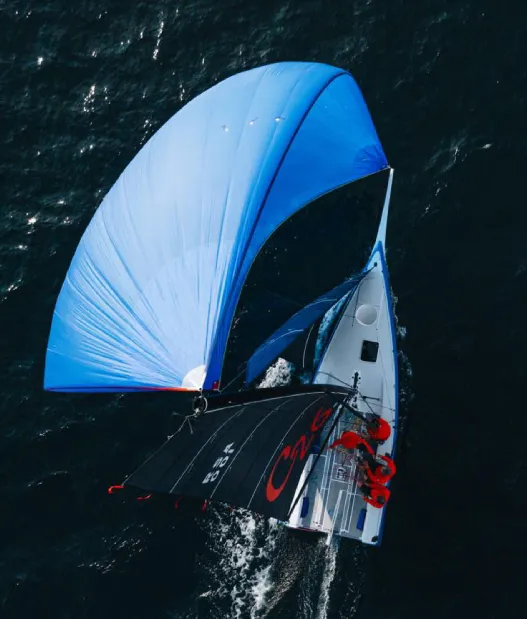
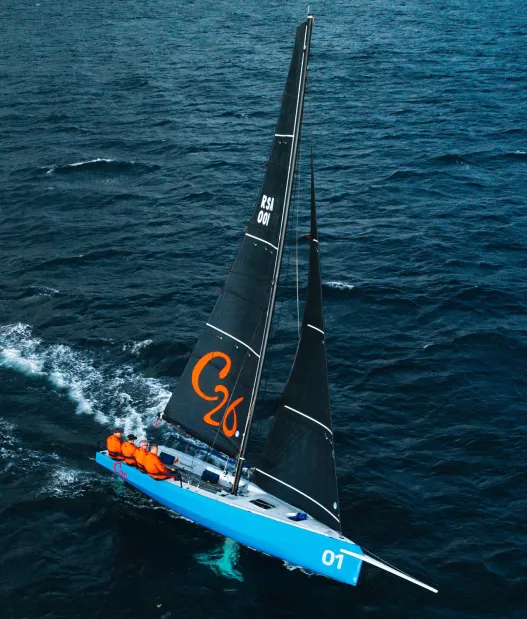
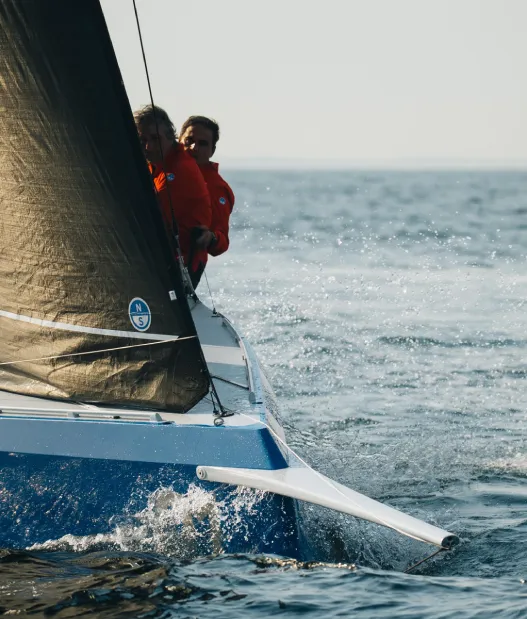
Hull number one took to False Bay for sea trials alongside Cape Performance Sailing, North Sails Cape Town, Negrinauta and her first European owners. Across a broad wind range, she matched her design polar with ease, sailing fast, responsive and well balanced.
In light air the C26 outperformed expectations. Once the breeze built, she stayed stiff, powerful and reassuring to sail, even with crew facing inboard.
“Fast, responsive, and exciting to sail.”
Davey James, Director, Cape Performance Sailing
1. Hull & Construction
Identical hulls, down to the kilogram.
Each Cape 26 hull comes out of the same split-mould process used on the Cape 31: two halves, laminated in E-glass and epoxy, then joined along a controlled structural seam so shape, stiffness and weight stay consistent boat to boat. At a fixed 950kg, the hull is light enough to get up and plane early, and stays quick when the breeze is soft. Every hull is checked, measured and issued a certificate before it ever leaves the factory, so in a true one-design fleet, it's the crew that decides the result, not the boat underneath them.
2. Keel & Appendages
Big-boat power, trailer-friendly draft.
A carbon foil paired with an approximately 440kg lead bulb forms the lifting keel, extending down to a 1.90m draft once racing. That depth hands the Cape 26 the righting moment and upwind pointing power you'd expect from a much larger yacht. Back at the ramp, the keel — with removable rudder — retracts to just 0.40m, so a grand-prix-spec boat can still be towed between regattas without drama.
3. Rig & Rigging
Rig tune you can put a number on.
The carbon mast is stayed with LightSpeed's LS Ion standing rigging — with titanium-insert terminations, chosen because it holds shape under load with far less stretch than rod or wire. Trimmers can power the rig up or back off without ever touching a shroud, since the forestay runs aft to the trimming pod and adjusts on the fly. A Cyclops wireless sensor on the forestay streams live tension data straight to a Vakaros unit or a phone, turning what used to be a feel-based setting into a repeatable number.
4. Sails
One sail plan, validated by three sailmakers.
North Sails, Doyle Sails and Quantum Sails all signed off on the class sail plan during development, with North 3Di supplying the first sails used in sea trials. On the wind, it's a 26.65m² square-top main matched to a fully battened jib — either the 18.20m² All Purpose Jib or the heavier-air Jib 3 — for 44.85m² upwind. Off the wind, an 81.80m² A2 spinnaker brings the downwind total to 108.45m². Full battens on both main and jibs keep shape locked in across the entire range and help with longevity.

5. Deck & Systems
Built to be worked, not just sailed.
Four or five sailors crew the Cape 26 in class racing (six if the whole team is women), seated inward with no hiking required — the 'Mills Ramp Deck' handles that, a cockpit designed around comfort and control with lines positioned to be hauled on repeatedly through a race. Open events can bolt on optional OSR stanchions if hiking is wanted. Every piece of deck hardware is Harken or Allen, set into a painted antiskid surface, and there's no cap on how much the crew can weigh.

6. Gennaker Retriever
The kite goes up and down, the crew stays put.
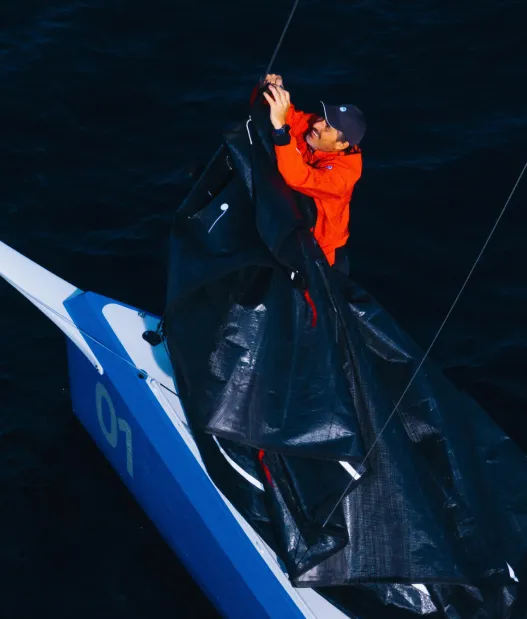
A bow launcher feeds the spinnaker up and a below-deck chute brings it back down, so nobody has to leave the cockpit to hoist or douse. Because the chute is sealed against the hull, water that rides in with a soaked kite runs straight back out the way it came, rather than pooling inside the boat. The payoff is quick, repeatable kite work and a bilge that stays dry.
7. Electronics
Every boat speaks the same data.
Every Cape 26 runs the identical instrument package — a single, compact, high-accuracy unit (Vakaros RaceSense or an approved equivalent) handling GPS, heading, heel and start-line timing. Locking the fleet to one approved system rules out an electronics spending war and means every boat reads the race the same way. Combined with the Cyclops forestay sensor, crews are all tuning off the exact same live feed.

8. One-Design Build
Paper-trailed from the mould to the start line.
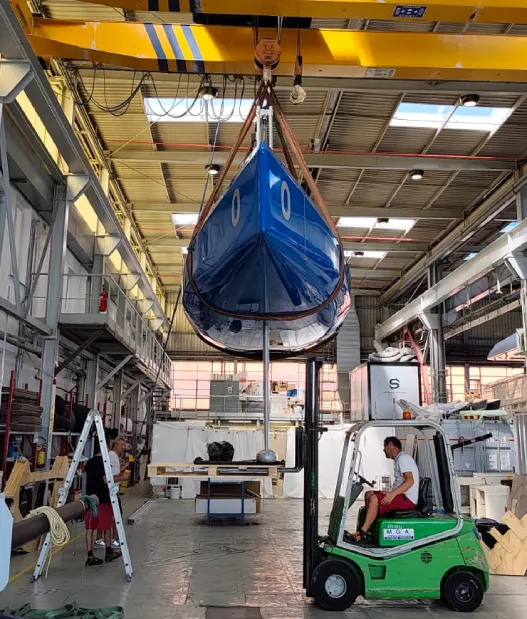
Cape Performance Sailing builds every hull at its Cape Town yard — the same facility that has turned out more than 65+ Cape 31s — and measures each one before it leaves the factory floor. A measuring certificate and a Boat Plaque travel with the boat from there, tying hull and rig to one closed specification on paper as well as in the mould. The upshot: every boat on the start line is genuinely alike, and the finishing order comes down to how it's sailed.
9. Electric Engine
No fuel tank, no fumes, no fuss.
Class rules mandate an electric outboard with its battery built in, rated equivalent to about 4hp — a propulsion choice that fits modern marina regulations and suits the realities of a racing programme better than a petrol outboard would. Only the drive leg sits at the transom in use; stowed, it’s mounted inside the hatch, so the unit is put away with ease.

Finished like a race boat. Down to the deck.
Measurement certificate: