
HIGHEST QUALITY, BUILT IN.
Masterminded by Lord Irvine Laidlaw and designed by Mark Mills, the Cape 31 is built by licensed boat builder Cape Performance Sailing Pty Ltd, in Cape Town, South Africa.
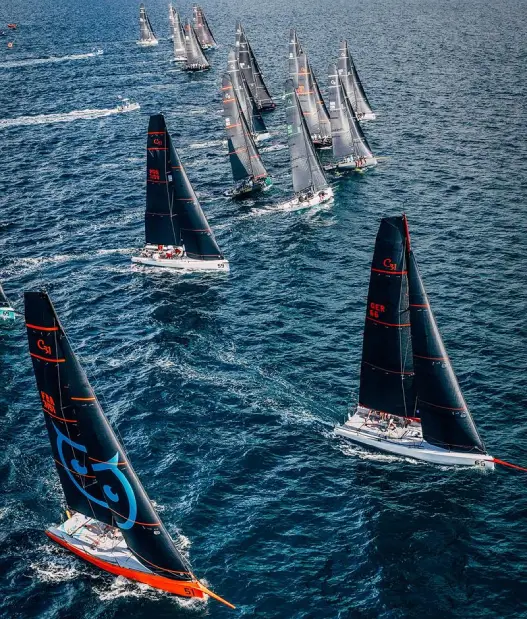
The boat is a proven pocket-rocket, with wins not just in one-design racing but also under IRC and ORC — at Les Voiles St Tropez, Giraglia Inshore, Palma Vela, Cowes Week, San Francisco Rolex Big Boat Series, Key West Race Week, New York Annual, Safe Harbor Regatta and UK IRC Nationals etc.
“A simple, clean high performance One Design without constraint.”
Mark Mills, Designer, Mills Design Ltd
1. Hull & Construction
One hull, one build standard, every time.
Every Cape 31 hull is vacuum-laminated E-glass over a foam core in an epoxy resin system, reinforced with carbon and cured in an oven post-cure cycle. Internal structures are built in female tooling to guarantee identical shape and stiffness from hull to hull, with carbon composite chain plates throughout. Displacement is set at 1,792kg. Hulls are finished in white as standard, with a non-slip deck coating and antifoul available on request.
2. Keel & Appendages
A deep, fixed fin built for pure upwind power.
A carbon fin keel carries a 710kg lead bulb to a fixed 2.45m racing draft, maximising righting moment and pointing ability. A carbon rudder stock, female-moulded blade, JEFA bearings and a carbon tiller with Spinlock extension complete the steering package, with a hydraulic tilting road trailer available to move the boat between events.

3. Rig & Rigging
A carbon rig, built to race and built to travel.
The carbon fibre mast splits into two pieces for shipping in a 40ft container, and carries rod rigging with two sets of swept spreaders and Cunningham control, plus one halyard each for main, jib and spinnaker. An aluminium boom with outhaul, a Cape 31 Windex reciprocal to the instruments, and a Harken head foil unit (per class rule) complete the rig. Southern Ropes supplies the full running rigging package, and a carbon fibre bowsprit carries the kite forward on a single tack line.

4. Sails
A wardrobe built for one design, IRC and ORC alike.
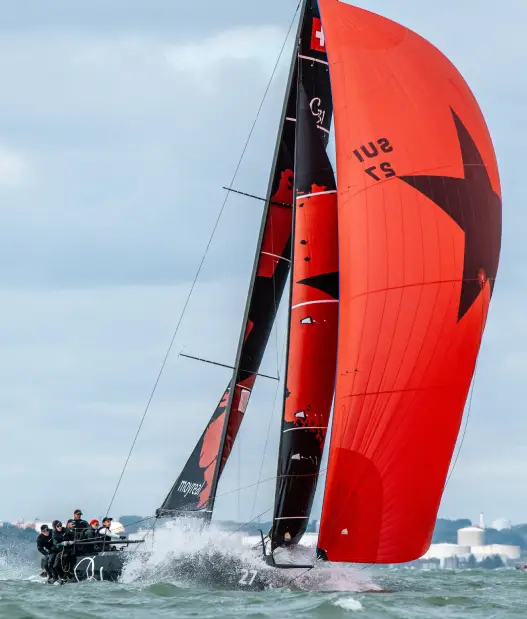
Class rules require a Main, an All Purpose jib, a Heavy Weather jib and two asymmetric spinnakers aboard while racing. The class-specification wardrobe totals 39m² on the mainsail and 25m² on the jib upwind, with a 116m² asymmetric spinnaker downwind — a sail plan that has taken Cape 31s to overall wins at Les Voiles de St Tropez, Giraglia, Palma Vela and Cowes Week under one-design and handicap rules alike.
5. Deck & Systems
A clean deck, built to be raced hard.
Harken Performa winches drive a 4:1 mainsheet traveller system, with course and fine mainsheet trim led to swivel-cam trimming pods and vang control led to the cabin top. Composite moulded stanchions and life lines meet OSR Category 4 requirements, with composite chain plates, XTR Spinlock jammers, Ronstan car tracks and folding padeyes rounding out a deck built for a crew of five to eight sailing to a 595kg total weight limit.

6. SPINNAKER HANDLING
Bowsprit-launched, down in one motion.
The asymmetric spinnaker tacks to a carbon bowsprit and comes down through a dedicated spinnaker take-down system, with a forehatch closing system sealing the foredeck once it's away. Aggressive hull chines produce the boat's signature bow-up attitude downwind, with owners regularly reporting planing runs in excess of 20 knots.

7. Electronics
Race-ready data, from basic to Grand Prix.
A Basic package puts wind, position, heel, trim, heading, speed and depth on a mast display, with the carbon mast bracket and installation included. The Grand Prix package steps up to full B&G instrumentation — two cockpit displays, mast displays, wind and depth/speed transducers, an electronic compass, forestay tension gauge and wireless data — installed, commissioned and ready to race.

8. One-Design Build
Measured, certified, and built at scale.
Cape Performance Sailing, Cape Town has built more than 65 Cape 31s to date, with hulls measured under the ORC International Measurement System and sails checked by a class or national ORC measurer. Racing to a design IRC rating of 1.15, the class combines strict one-design manufacturing with genuine competitiveness under IRC and ORC rating rules — with established circuits now running in the Mediterranean, the UK, South Africa, the USA, Australia and Hong Kong.

9. Auxiliary Power
A diesel inboard, built to get you home.
A Yanmar 2YM15 15hp diesel drives a folding two-blade propeller through an SD20 saildrive leg, run from a single engine-start control panel with Spinlock throttle control — enough to get home safely under power without carrying weight that costs speed on the racecourse.

Finished like a race boat. Down to the deck.
Measurement certificate: